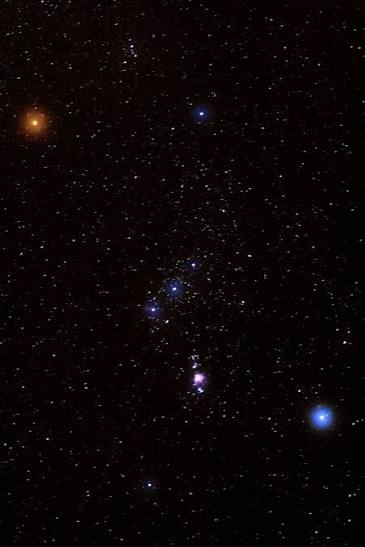
Go outside on a clear winter night and find Orion. A boxy rectangle defined by four very bright stars. A belt. It’s the easiest constellation there is. Some say the smudge of stars hanging off the belt is a sword. Others say it’s something you can only see with a subscription to his OnlyStars. Because almost every star that makes up Orion is a freak.
Betelgeuse, the red shoulder, is a supergiant so large that if you dropped it into our solar system in place of the sun, its surface would swallow past Mars. Rigel and Alnilam — the opposite foot and the center of the belt — are blue supergiants each throwing off something like 120,000 times the sun’s light. The smudge in the sword isn’t a star at all — it’s the Orion Nebula, a stellar nursery actively manufacturing new stars out of gas and dust. Star for star, Orion is a lineup of the rarest, shortest-lived objects the galaxy makes. Only one star in the whole constellation is what you’d call ordinary, run-of-the-mill. Everything else is a freak of luminosity, size, or both.
But the Orion constellation isn’t a weird exception. It’s the rule. Look at any constellation and you’re looking at a rogues’ gallery of the biggest, brightest, most temporary stars the galaxy has to offer. The Big Dipper, super rare stars. Cassiopeia? You get the idea.
Wait. Isn’t this blog supposed to be about fundraising? Don’t worry, we’ll get there. We need to talk a bit about visibility and rarity first.
What you probably don’t know is that the most common type of star in the Milky Way — the ordinary, patient, everywhere kind of star — can’t be seen by the naked eye from Earth. They are so dim that you can’t see them. Not from a rooftop, not from a mountain, not from the middle of the desert on the clearest, darkest night of the year. It’s invisible to us, full stop.
75% of the stars in the whole galaxy are missing from our survey of the night sky.
The stars you can’t see
Astronomers call this phenomenon Malmquist bias, after the Swedish astronomer Gunnar Malmquist, who first described it in 1922 and elaborated on it in 1925. The core idea: in any survey with a brightness (or apparent-magnitude) limit — and your naked eye absolutely has one — you will preferentially detect the intrinsically brightest objects, because they’re the only ones visible across the largest volume of space. Nearby, you can see faint and bright objects. Farther away the only stars you can see are the super luminous ones.
Here’s why: visibility isn’t really about how bright a star is. It’s about how far its light can travel and still register against the dark. Move our sun out past roughly 55 light-years and it drops below what the naked eye can detect — that’s the entire bubble in which an ordinary, sun-like star is visible to us. A supergiant throwing off 100,000-plus times as much light stays visible from a thousand light-years out, or more. And because you’re not measuring a distance, you’re measuring a volume — the space inside a sphere — that difference isn’t a slightly bigger circle. It’s thousands of times more space from which a rare, luminous star can be spotted, for every sliver of galaxy an ordinary star can be seen from.
Early astronomers only looked at these stars, because these were the stars they could see.
But red dwarfs — small, dim, slow-burning stars that sip their fuel for trillions of years — make up roughly three-quarters of all the stars in the Milky Way. They are, by a wide margin, the most common star there is. And there is not one of them bright enough to see without a telescope.
“You are not seeing the sky. You are seeing a luminosity contest, and almost every contestant is lying about how common it is.”
This isn’t ancient knowledge, either. The idea that the galaxy is dominated by dim red dwarfs rather than the bright stars in our constellations is a relatively modern correction — it took increasingly sensitive surveys and large-scale stellar censuses through the 20th century before astronomers could reliably account for it. What your eyes hand you, even now, is still the most biased sample. Only the instruments that astronomers were using changed; the bias in unaided observation never went away.
Aren’t you on a fundraising blog? I think we might be stepping closer to the point. Hang in there.
How what we know about stars applies to fundraising
Here’s the thing about measurement bias: it’s not a quirk of astronomy. It’s the default behavior of any system: you can only see the things that your tools can see.
And this is hurting fundraising.
Fundraising has its own version of the night sky, and I think most of us have been staring at Orion without realizing it.
Wealth screening flags donors based on visible capacity indicators — real estate records, stock holdings, past major gifts, public giving to other organizations. RFM scoring ranks your database by recency, frequency, and dollar amount of giving you already recorded. Gift officer attention, understandably, gravitates toward whoever is already lit up on a dashboard. All three tools work exactly the way your eyes work on a clear night: they surface what’s bright and miss everything that isn’t, and they mistake “what I can currently detect” for “what’s actually out there.”
“Wealth screening finds bright stars. It was never built to find red dwarfs.”
The donors those tools are structurally blind to aren’t rare. They’re the majority. They’re the fixed-income retiree who’s given $75 a year for three decades without a single lapse. They’re the volunteer who’s never once appeared on a capacity screen because nothing in a public record hints at what she’s actually worth. They’re quiet, patient, numerous, and — like a red dwarf — putting out a signal too dim for your standard instruments to pick up.
Every gift officer has a story about the modest, unflagged donor who turned out to have a seven-figure bequest tucked into an estate plan nobody saw coming. That story isn’t an anomaly. It’s Malmquist bias, wearing a cardigan.
“The donor who never tripped an alert isn’t absent from your data. She’s a red dwarf. She was always there. You just didn’t have the equipment to see her.”
What the data actually says
This isn’t just a nice metaphor — it shows up directly in the numbers. Bequest and planned-giving research consistently finds that a typical bequest secured through active stewardship runs somewhere in the neighborhood of 200 to 300 times the donor’s total lifetime giving to the organization. The gift is enormous. The visible signal that preceded it — the annual giving pattern a screening tool or RFM score would have picked up on — was tiny.
GivingUSA research on planned giving similarly finds that most bequest donors had a giving relationship with the organization stretching back 20 years, almost always at the annual-fund level, almost never flagged as major-gift caliber along the way.
Prospect research has even started naming the blind spot directly. Practitioners increasingly talk about “hidden gems” — donors who score low on engagement/RFM metrics but high on wealth or capacity indicators once you actually go looking. The fact that this needed its own label tells you something: the standard tools weren’t finding these people. Somebody had to build a second pass specifically to catch what the first pass was designed to miss.
Bequest giving alone has held steady at 8 to 10 percent of total U.S. charitable giving for four decades — in 2025 it totaled $62 billion and was the largest increase of any type of giving. That’s not a rounding error sitting outside your major-gift pipeline. That’s a red-dwarf-sized share of the galaxy, quietly generating most of the actual mass while your instruments stay locked on Orion.
Which, of course, means that you are missing a galaxy of opportunities.
Seven ways to build red-dwarf awareness into your fundraising program
Run a “hidden gems” cross-reference. Pull your wealth/capacity screening scores against your RFM or engagement scores and flag anyone who’s high on the first and low on the second. That mismatch is exactly where your instruments are failing you.
Give tenure its own weight, separate from gift size. A $100-a-year donor of 25 years is a fundamentally different data point than one of 2 years. If your segmentation only sorts by dollar amount, you’re throwing away the one signal red dwarfs actually give off — persistence.
Put a floor under your legacy-society ask, not a screening gate. Don’t restrict planned-giving conversations to people who screen as high-capacity. Offer the ask broadly to anyone with long, consistent tenure — that’s the population the bequest data says you’re actually looking for.
Schedule a periodic “no-flag” outreach pass. Build a light-touch check-in — a call, a handwritten note, an invitation — that goes out to your longest-tenured, never-flagged donors on a schedule, not as a reaction to a screening alert. Give the quiet ones a chance to signal back.
Train gift officers to distinguish “detectable” from “valuable.” Screening tools measure what’s visible. Make sure your team knows that consciously, so “not on my radar” doesn’t quietly become “not worth my time.” Motivate them by telling them you know they’ll get conversations in this group, and high response.
Audit how your major-gift pipeline actually gets built. Look at your current portfolio and ask how many names got there because a screening tool lit up versus because someone noticed a relationship. If it’s almost entirely the former, you don’t have a research problem — you have a visibility problem.
Revisit your “no” and “not yet” lists on a real cadence. Wealth and readiness change continuously; in many shops your screening refresh doesn’t happen continuously. Someone who wasn’t a complete fit two screening cycles ago may be one now, sitting there at the edge of what your equipment can pick up.
None of this means your screening tools are wrong, any more than your eyes are wrong about the night sky. They’re just partial. They were built to detect what’s bright, and bright is not the same thing as common — or valuable.
Go back outside and look at Orion again. It’s still there, iconic, and still made almost entirely of the rarest stuff in the galaxy. But the sky you’re not seeing — the vast, dim, patient majority quietly outnumbering everything you can actually pick out — is the one doing most of the work. Your donor base has one too. The question isn’t whether it’s there. It’s whether you’ve built anything capable of seeing it.
Chad Bonaker is chief storyteller at Giving Geek Consulting, and co-author of The Donation Equation.